
Back in 2021, when we moved to the mountains, we found a tiny two-room space on a hilltop and decided to make it our work space. We spent the first month waiting for a three-phase electricity connection to be installed. Then one day, we were out for the whole day running errands and returned to the much-awaited news - in our absence, the connection had been installed. After a long wait, we were so thrilled that we could finally start working and that is exactly what we did the next morning. We simply walked in and pressed the start button – on both, our work mode and our equipment. But in the three years that we worked from that space, every so often I felt that we had missed something. There was nothing that marked or delineated this beginning. No physical act that conveyed that this is the opening of a new chapter. What we had missed is what I now spend a great deal of time thinking about – Ritual.
But in times when a multi-step skincare routine, a gym bro’s ice plunge and protein shake routine and a morning cup of coffee are all sold as rituals within seconds from each other on our social media feeds, what do rituals even mean? I remember coming across a piece called “rituals of famous creative women” which recounted deeply personal and oddly specific practices of some of the greatest writers and artists that we know of. Joan Didion, for instance, started her morning with coca cola and almonds. She wrote during the day and in the last hour had a drink to get “loose enough” to edit. Towards the end of finishing a novel, she slept in the same room as the manuscript, because in her words “somehow the book doesn’t leave you when you sleep right next to it”. Artist Georgia O’Keeffe woke up at dawn, made a fire and tea, watched the sun rise. Used to go to her studio at 7:00 am, worked through the day, and ended her day with a long drive after supper.
The process, life and inner worlds of creative women are deeply fascinating to me. But the more I contemplate rituals, the more I wonder, were these rituals or simply routines that worked for them and what is the difference, if any, between ritual and routine?
When I set out writing this piece, I had a simple enquiry in my mind – how to create personal rituals, that are uniquely our own, birthed from our own lives and experiences. Somewhere along this enquiry, I came across Bruce Feiler, the author of “A time to gather” speaking about rituals in a podcast . He defines rituals as “a shared unnecessary act that makes us feel at home”. Interesting.
I understood the unnecessary part. It is not something that we absolutely need and yet it is something that we just do. One does not need a priest and a ceremony to get married. One does not need to have a baby shower in order to give birth. Similarly, the end of the human life also does not need funeral, rites, memorials etc. Yet, across cultures, we have rituals marking these major life events because rituals give our experiences meaning. They create space for us to be witnessed and for us to witness others.
I also understood the coming home part. Over the past almost three years, I have conducted Oona’s cacao immersions in different settings and contexts. My personal favourite is when I get to do it in a forest. Through these immersions, I have had the honour of witnessing many homecomings unfold in front of my eyes and I recognize one when I see one. To my delight and surprise, in the context of rituals, Bruce himself recounts a personal experience of forest bathing with a group in Chile and he calls it a ritual, which by his own definition, it is.
But I was still stuck on the “shared” part because while I understand that shared rituals are important for our connection with each other, I was still interested in the personal. Because that is where most of our lives are lived. But then if a ritual is necessarily shared, does that leave personal rituals as mere performances or frivolities?
One of my earliest memories of a personal ritual is my grandmother going into the garden every morning and offering water to the sun. There was no congregation. With her head bowed, she poured water from a vessel and ended this offering with a symbolic circumambulation. Looking back, it was an embodied ritual of devotion and gratitude towards the sun god and not a performance. The thing is, we need both – the collective and the personal.
Between our shared rituals, there is still a complex, interior life that each of us has to navigate. What do we do in moments when we don’t have a circle and no one to hold space for us? That’s when we need to turn towards our inner wisdom and hold space for ourselves. This is where our personal rituals help us find our centre. And maybe the personal is not separate from the collective after all. My grandmother’s ritual came from something that already exists in our collective wisdom, in rituals older than her. Our personal rituals can carry the same essence. I think of them as filling a pitcher with water from the river of collective wisdom. It is the same water, carrying the same quality, but it takes the shape of the pitcher that you are holding, and meant to quench you specifically.
Perhaps this is also why rituals sit somewhere between the ordinary and the sacred. They offer a bridge to something higher than ourselves or should I say, our higher selves, or maybe god, divinity, universe, wisdom, magic, whatever may the term of your choosing. I love Maria Popova’s description of the difference between routine and ritual – “while routine aims to make the chaos of everyday life more containable and controllable, ritual aims to imbue the mundane with an element of the magical. The structure of routine comforts us, and the specialness of ritual vitalizes us” . While Joan Didion's coke drinking and almond munching may look like only a routine, her sleeping in the same room as the manuscript could be something else entirely – a way to stay in communion with the creative forces in the liminal space of sleep. Maybe as Georgia O'Keeffe sipped her tea and watched the sun rise, she too was touching something symbolic, the kind that lives in our collective subconscious and not so different from my grandmother's ritual. Casper ter Kuile says rituals are made of intention, attention and repetition. Maybe, sometimes, the difference between a routine and a ritual is not always in the act itself. Perhaps it is in the way we inhabit it.
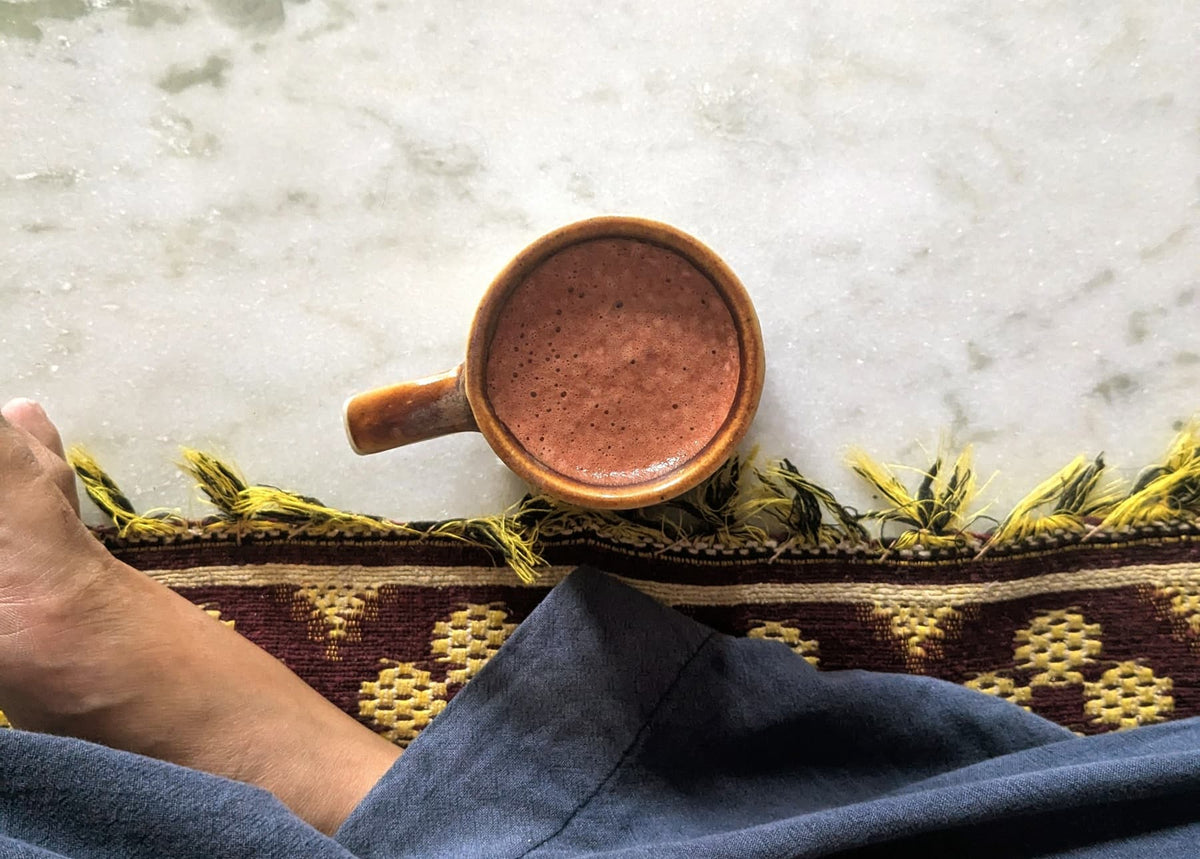
When we moved to Ranikhet, before we started working from our new space, we bridged the gap that we had left the first time around by observing a ritual of our own. We had a cup of cacao, meditated under the angel’s trumpets, I wrote a letter of prayer for Oona and planted trees. Before I planted my tree, I placed my letter in the hole I had dug for the tree and planted my tree over that letter, believing that my prayer will fuel not just the tree, but Oona and the space itself. This ritual may not have resembled any of our known rituals and yet it carried that essence and felt true to us.
The truth is, we need rituals now more than ever. And we also need new rituals, ones that can give meaning to many of our life experiences, transitions, endings, grief, joys, breakthroughs that do not necessarily find a reference or place in the rituals that we have inherited, most of which come from tradition or organized religion. This is the space in which our personal rituals can emerge and help us find our centre as the world goes around. Perhaps these personal rituals can then fuel the collective too, as we share them with our communities or build communities through them. This is the space from which Oona’s cacao immersions have emerged. They are a culmination of both – my personal rituals and something that already exists in our shared human wisdom.
Maybe the real question is not how to build a ritual, but where you already feel yourself coming home and how to return there, with intention, attention and repetition. That return itself is the ritual and the sacred. So instead of attempting to answer how to create a personal ritual, let me leave you with a few questions to sit with and may be your personal ritual is already hiding in your answers.
- What in your ordinary life feels like coming home to yourself?
- What do you return to again and again, without being told?
- Looking back at your childhood, what were some things that you remember being deeply immersed in?
- Which shared or collective ritual has stayed with you? What part of it do you still long for?
- What already carries your intention and attention, even if you've never called it ritual?
If you already have a personal ritual and are willing to share, we would be delighted to receive it.
[1] This Jungian Life, Ritual: Finding the centre in a turning world - https://thisjungianlife.com/ritual/
[2] The Difference Between Routine and Ritual: How to Master the Balancing Act of Controlling Chaos and Finding Magic in the Mundane - https://www.themarginalian.org/2015/02/13/routine-ritual-anne-lamott-stitches/
Share: